
The Mental Health Toolkit for Dealing with Difficult Times

Getting fresh air and exercise by hiking with my dogs, Shenanigan (AKA Neneh) and Kaya, has been an important part of my self-care and making it through tough times.
Why am I writing about mental health on a survival website? Because it’s crucial in making the best decisions possible when you’re dealing with crisis situations.
September is Suicide Prevention Month. And while you might not be feeling suicidal, someone you know likely has dealt with these thoughts—and they could use your help.
Suicide is the 10th leading cause of death in America, and it’s been on the rise for years. Making things even worse, 2020 has been, to put it gently, a complete and utter shitshow, putting both us as individuals and as a society through the wringer.
The COVID-19 pandemic has killed nearly 200,000 Americans. Stoked by fear-mongering, big money and foreign meddling in politics, and a president without a plan, sociopolitical unrest is dividing the United States. Oh, and the wildfires that are ravaging California and Colorado (including the largest in the latter’s recorded history) are but a small symptom of the climate change that’s destroying the place we all call home and having countless impacts on our collective well-being.
Not only are we being impacted by all of these disasters, but you’re likely dealing with personal struggles in your life, too. I am: I was laid off from a job that I moved halfway across the country and gave up a lot for just over a year ago, and almost four months later, I’m still unemployed.
Thankfully, I’ve been through tough times before that are helping me get through the cascade of emergencies we’re facing now. Over the course of the past decade, in addition to a physical emergency kit (read more about how to put yours together here), I’ve developed this Mental Health Toolkit that helps me get through the worst times while ensuring better things are in store.
The Mental Health Toolkit includes:

Losing Pixie, Diva, and Aja (left to right) within half a year in 2015 was one of the most difficult experiences of my life. Thankfully, Kaya and Gaston are still alive and well, and I learned a lot that year that has helped me since.
“Do what you can with what you have at the time.”
2015 was the year from hell for me. First, I had to make the difficult decision to have Diva, the husky/lab mix whom I’d adopted when she was a puppy in 1999, euthanized in my home.
A few weeks later, the vet discovered untreatable late stage cancer in my yellow lab, Pixie—she had to be euthanized the next day. (Her birthday is this week. Rest in peace, Pixie.)
After another few stressful weeks, I separated from from the woman I’d been in love with for eleven years.
One morning several months after that, while I was staying at my parents’ place, my dad called up the stairs, “Tristan…” He discovered Aja, Diva’s sister, dead on the office floor, probably from heart failure, a common cause of death in older dogs.
A few weeks after that, I was divorced.
I didn’t know if I could make it through the final quarter of the year. Hell, after so much loss, I didn’t know if I wanted to.
Thankfully—and crucially—I still had my loving family and a supportive network of friends. Perhaps just as importantly, I found a mental health therapist who helped me survive it all during weekly visits. (Word to the wise: Don’t just settle for the first therapist you talk to. Get recommendations from friends and family, make appointments with several experts, and choose the one you’re most comfortable with.)
One crucial piece of advice that my therapist shared with me repeatedly was this phrase: “Do what you can with what you have at the time.”
When I first heard this, I immediately thought it was a line of bullshit to give anyone the excuse to do anything.
But as he explained it, in any given situation, we do the best with the tools we have and the circumstances we’re dealt. That’s literally all we have. Our entire lives lead up to where we’re at and what we’re dealing with now—and how we can get through it.
In crisis situations, we probably don’t have exactly what we need. Nothing’s perfect. Our mental faculties might be impaired due to high-running emotions and adrenaline, drugs, or elements we just don’t have control over. We often don’t have the tools that would objectively solve the problems we find ourselves in.
But at any given moment, we’re in the result of what’s basically a lifelong equation that leads up to that point, and we’re working with the tools available to us to make the decisions that seem best at that moment.
As Annaka Harris says in a guided meditation in the Waking Up app (more on that below), we have to “be with what is”.
It sounded trite to me at first, but now I know: There’s absolutely no other way to get through anything than to do what we can with what we have at the time.

Photo by Nick Bondarev from Pexels
How to Find the Mental Health Tools That Work For You
For years before the calamity that was 2015, without fully realizing it, I had relied on various resources and practices to help me deal with difficult circumstances and appreciate the positive aspects of my life.
From the time I could write, I’ve kept journals documenting everything from vacations to stressful events, major and minor.
I’d underlined and referred to countless passages in a stack of what are effectively self-help books.
I’d exercised off and on and talked with friends and family when I needed advice.
But it wasn’t until speaking with my therapist five years ago that I discovered that I had assembled a virtual toolkit to help me through difficulties. It took a lifetime to put it together and to realize I had invaluable tools at my disposal.
The recommendations below will be a good start for you to build your own Mental Health Toolkit. Some might be obvious, some not so much. And if something doesn’t work, don’t beat yourself up about it. If you want to add something that already helps you, go for it. The point isn’t to do everything that’s worked for me, but rather to start and build an accessible go-to list of things to do when you’re feeling shitty and dealing with difficult situations.
Everyone is different, but we’re similar in more ways than we’re often led to believe by politicians, religion, and the media. Though I assembled the following resources, practices, and behaviors to help me, I know they can help you, too. These tools are tried and true, scientifically researched and proven to work.

A view of summer wildflowers on a recent hike more than two miles above sea level outside of Leadville, Colorado - Photo by the author
Exercise and Fresh Air
Oh, that dreaded word: exercise. We know we need it, but often, we don’t want to do it.
Thankfully, it’s not difficult to get the CDC’s recommended 150 minutes of exercise a week, and activity tracking apps can easily encourage you. Google’s Fit, which is part of my phone, even shows how my daily activity compares to the CDC guidelines, and I can enter virtually any physical activity I do, like skiing and hiking.
I take a 20 minute walk with my dogs on most days, which simply and quickly gets me to ⅔ of the CDC’s recommendation. (If you don’t have a dog, adopt one: They’ll motivate you to move.)
I also use an anti-repetitive stress injury (RSI) app on my laptop called AntiRSI that reminds me to get away from my computer every hour. If you do this for just five minutes throughout the workday and take a quick walk, you’ll get simple exercise, fresh air, and likely come up with ideas to solve some of the problems you’re facing in work or your personal life.
With the pandemic still raging, you might not want to go to a gym or yoga studio. Thankfully, many are offering steeply discounted online courses with convenient schedules.
I use Johnson & Johnson’s 7 Minute Workout app. A few circuits of that three or four days a week, combined with a walk or hike with my dogs, easily puts me over the 150 minutes of recommended weekly exercise.
And with your phone’s activity tracker, you’ll find that even cleaning your house can help you. Open the windows for some fresh air and it’s even better for you.
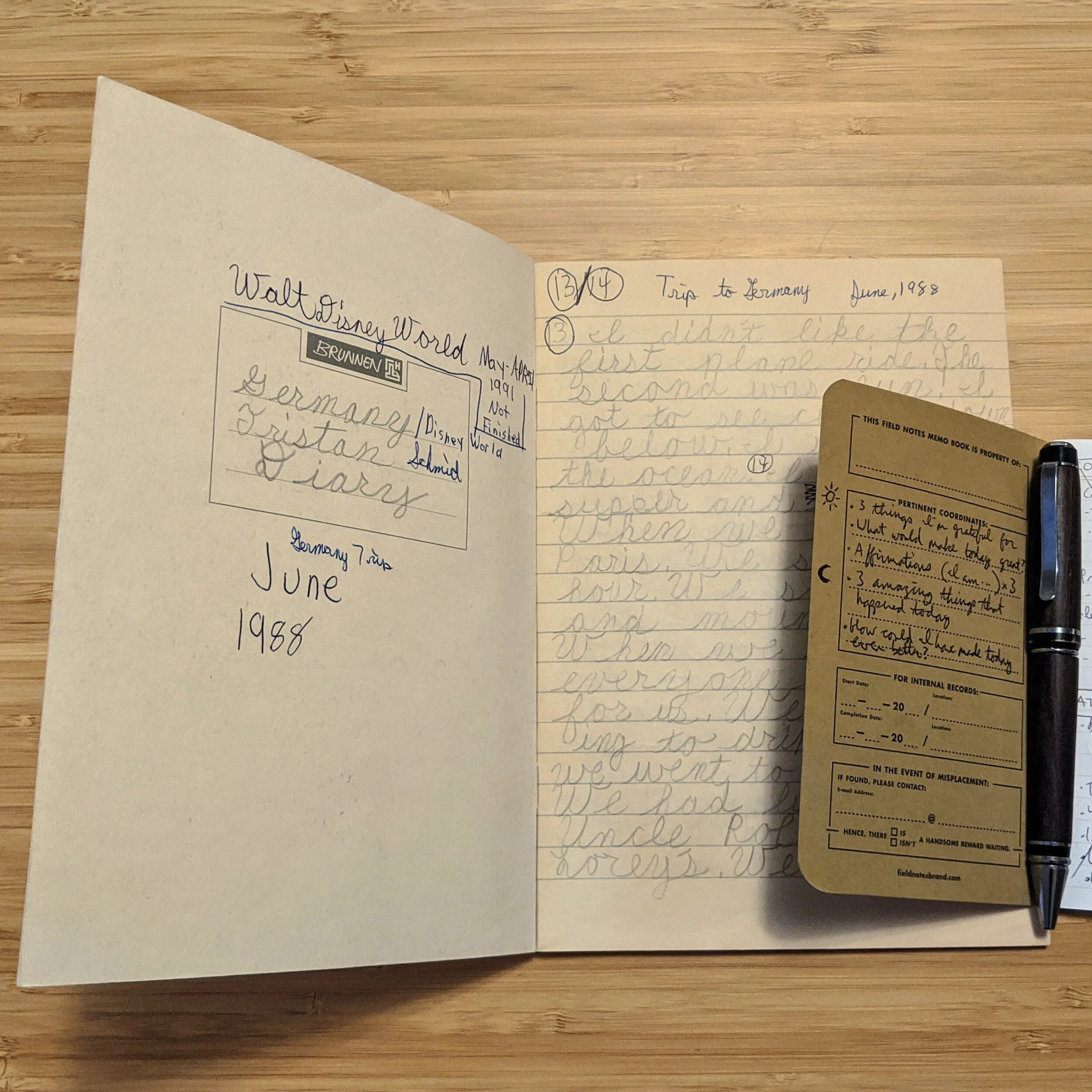
My first journal (left), my most recent gratitude journal, (with daily prompts), and my favorite pen, heavy and handmade by a local woodworker.
Journaling
There seems to be a stigma against journaling—that it’s only for middle-school girls or weaklings—but I’ve never cared, perhaps because I’ve always enjoyed writing.
I remember journaling for the first time when I was eight years old on my first visit to Germany to visit family. I still have that journal—along with dozens of others that document the best and worst times of my life.
Research has proven that journaling for as little as 15 minutes twice in one week helps with particularly distressing times in our lives, reducing symptoms like depression, anxiety, and hostility.
Maintaining a daily gratitude journal has been shown to improve happiness, too. It’s easy. Every morning, simply write down three things you’re grateful for. Then answer the question “What would make today great?”. Finally, write three affirmations: for example, “I’m happy. I’m healthy. I’m confident.” At night, write down three amazing things that happened that day, then answer the question “How could I have made today even better?” Contemplating your appreciation of what you have before bed can help you set the tone for a good night’s sleep.
Your daily gratitude journal entries don’t have to take more than a few minutes. They don’t require a ton of thought. And there’s no reason to worry if you’re writing the “right” things: The point of this exercise is to repeat the practice enough so that it becomes second nature. You’ll soon find that you’re appreciating the people and experiences in your life more often and more fully.


If you prefer to use a dedicated journal with pages already filled out with the simple prompts that I mentioned, check out The 5 Minute Journal, pictured above. (Note: The only money I receive through this website, which costs money—and time—to run, is through Amazon Affiliate links like this one. The item won’t cost you any more to purchase, but I’ll receive a small percentage.)
The affirmation aspect of the gratitude journal helped me significantly. My self esteem was in the gutter after my marriage dissolved. I second-guessed countless decisions I had made. I felt worthless. Including three quick and simple affirmations in my gratitude journal every morning slowly helped to build my perception of myself back up to the point that I realized that my life had value—and that I would survive.
And you don’t just need to use a gratitude journal. It’s okay to write about negative things, too. In early 2015, before I found my therapist, I didn’t know what to do with my thoughts. I was journaling incessantly, filling journals in a matter of days. Thankfully, I discovered that simply setting a 15-minute timer while journaling once a day allowed me to vent enough without letting my emotions burst forth nonstop like a firehose.
For more quick tips on the benefits and how to get started, check out this 13-minute NPR Life Kit episode on journaling.

Contrary to popular belief, you don’t need to use specific poses, be Buddhist, or sit in a silent room to meditate. You can do it anywhere, even while walking or brushing your teeth. Photo by Noelle Otto from Pexels
Meditation
Ah, meditation: another positive word with negative connotations.
I first started learning about meditation when I gravitated towards Buddhism in middle and high school after quickly becoming disillusioned with Catholicism in grade school. While I enjoyed them, most of the Buddhist texts I read focused more on fantastical stories of the Buddha and cycles of inherent suffering in our lives and less on instruction about meditation.
Then I discovered Jon Kabat-Zinn’s Wherever You Go, There You Are: Mindfulness Meditation in Everyday Life. Kabat-Zinn was one of the first Westerners to scientifically research the benefits of meditation, and he created mindfulness-based stress reduction (MSBR) programs which you can take online and are offered in-person (during non-pandemic times, at least) across the country.
Wherever You Go, There You Are focuses significantly less on Buddhist history and stories and more on the instructional aspects of meditation, with the goal of increasing mindfulness.


I’ve probably read and referred to this book more than any other in my life, and I’ve purchased and given it as gifts numerous times. Kabat-Zinn is a great writer, and the book is easy to digest. The chapters are typically a couple pages long and will only take you a few minutes to read, and most end with a brief, easy, and beneficial guided meditation.
Decades after Wherever You Go, There You Are was written, meditation continues to be scientifically studied, with obvious proponents of the ancient practice like the Dalai Lama working alongside researchers with modern technology to discover how it positively changes the brain, resulting in numerous mental, physical, and emotional benefits.
While Wherever You Go, There You Are is a great place to start, instructional audio is also beneficial when getting into meditation. I first started using the Stop, Breathe, Think app (also called MyLife Meditation) five years ago to help with my daily meditation practice.
Then neuroscientist and philosopher Sam Harris released Waking Up, which I’ve used for over a year and is my go-to for guided meditations. It features an amazingly simple yet effective 28-day introductory course with short sessions to help you ease in to daily meditation. Once you go through the intro series, you can either use the daily meditation—which is always new—or a number of other themed, guided meditations. Its user-friendly interface also features a basic meditation timer, and unlike other meditation apps I’ve tried, it offers a host of audio interviews that Sam has had with luminaries the likes of Leo Babauta (Zen Habits) and Loch Kelly (who has also collaborated with neuroscientists to study the benefits of awareness training). These experienced practitioners, teachers, and philosophers share even more insights and tips about how to live your best life based on the theories behind mindfulness meditation.
While there is an annual subscription fee to the Waking Up app, you can use this link to get the first month of Waking Up for free (I get no kickback from this). However, if, like many—including yours truly—you’re facing financial hardship, you can email Sam to get a free subscription until you get back on your feet.
I often hear that my friends and family just don’t have time to meditate. Start using Waking Up, and you’ll find that taking five or ten minutes out of your daily social-media-surfing or Netflix streaming to meditate is well worth it.
Another key thing to keep in mind about mindfulness meditation is that it’s agnostic. Though Buddhism is typically what comes to mind when one thinks of meditation (after all, mindfulness meditation is part and parcel of the religion), both practitioners of all religions and adherents to none can practice it without any associated sectarian dogma, all the while discovering that it increases their empathy for others and enjoyment of their own lives.
For more about the basics of mindfulness and getting started with meditation, check out mindful.org.

Gotta admit, I kinda miss these things. Photo by Fei Peng Hu from Pexels
Contact Friends and Family
Like exercise, this is another item in the toolkit that might seem obvious but is particularly important to be reminded of when you’re struggling. And during the COVID-19 pandemic, when social isolation has been dramatically increased amidst a global crisis, staying in touch is crucial to maintaining your baseline mental and emotional health.
We are social creatures, and even the most introverted among us need the support of others every day—especially when we’re facing hardship. Science has proven this.
I’m quite an introvert, but I’ve found that when I’m feeling down or facing a problem, sending a quick text message or calling a good friend or my family inevitably makes me feel better.
The people you contact will feel better, too. You’ll often discover that those you reach out to are feeling some of the same emotions you’re going through, and contacting loved ones can also help them feel better. You’ll probably find, too, that you’ll receive insights into your dilemmas that weren’t evident before you reached out.
For more about the tremendous impact of socializing, I encourage you to sign up for the eight-week Science of Well-Being course. It’s available for free this year, and you can take it on your own time, without scheduled classes.
The Science of Well-Being is led by Yale Professor of Psychology and The Happiness Lab podcast host, Lori Santos. The course is packed with scientific evidence about the benefits of keeping in touch with people. You can receive a certificate for completing it, and it offers tips on the positive impact of meditation, exercise, and other items in the Mental Health Toolkit.
“You are not alone.”
If you’re feeling down and you reach out to friends or family but they don’t respond right away, don’t fret. When that happens, you might lean on your favorite radio station or podcast: hearing other human voices can help when you’re alone.
I typically start streaming my favorite radio station, KEXP, when I’m feeling alone after I’ve reached out to people but haven’t been able to get in touch with them. Listening to a great range of music helps, and more often than not, hearing the voices of the DJs and stories from listeners reminds me that, in the words of The Morning Show host John Richards, “You are not alone.”

Get Creative
I’ve written, drawn, and made music throughout my life. Sadly, I’ve found that I too often stop doing those things when I get busy with work or stressed with other difficult circumstances, though I know that those times are when I need to create to help myself through the struggles.
So schedule a chunk of time, even just half an hour or an hour a day, to keep up with the hobbies that you love or start a new one.
Buy the supplies you need. Watch YouTube videos for tutorials and inspiration. Start writing a blog about what matters most to you. Prep your custom emergency kit and plan for your family. Do something that you enjoy to keep your mind occupied, release the energy of frustration, and keep your sanity.
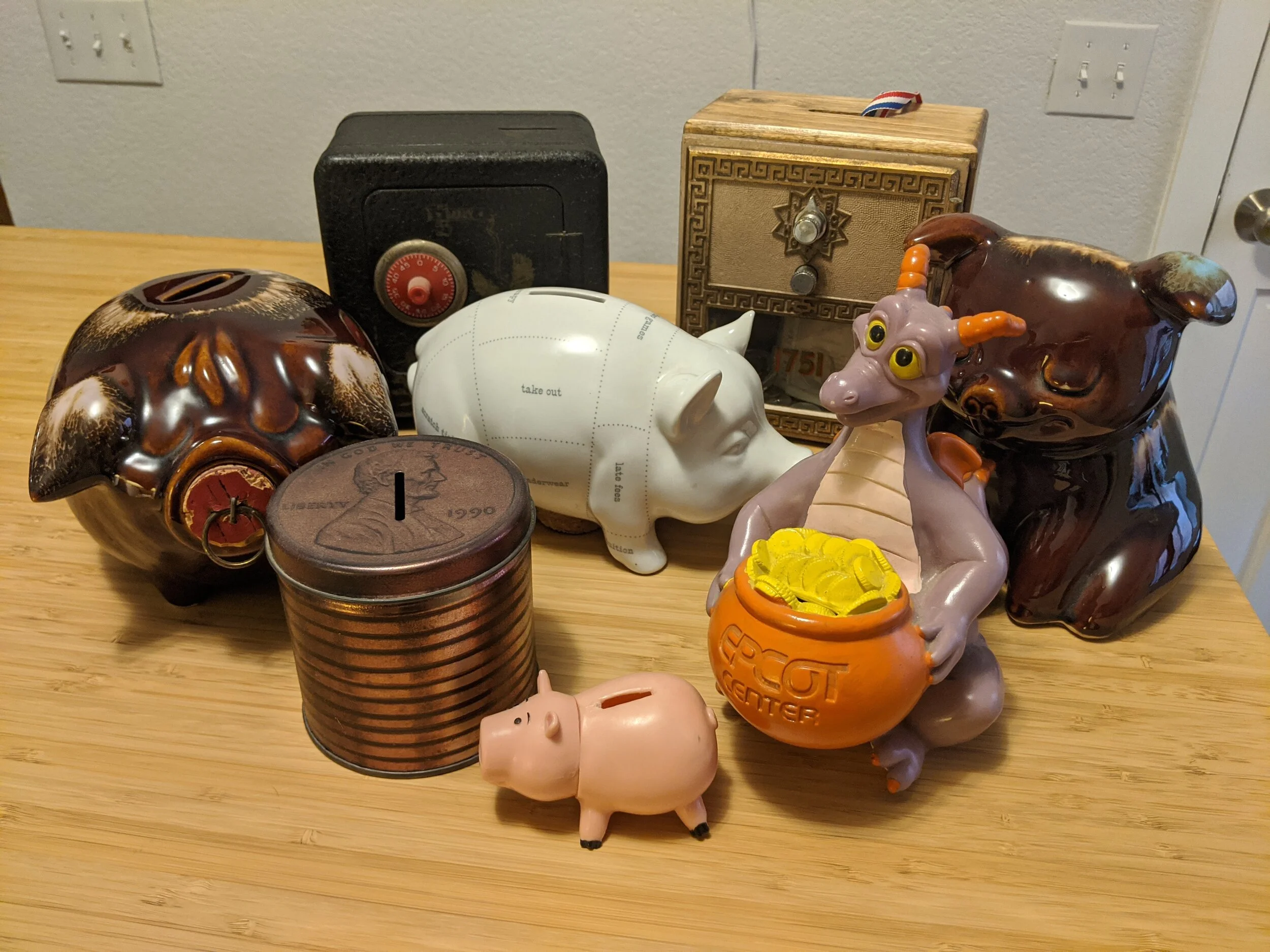
Part of my piggy-bank collection. I’ve had the one at far right my whole life.
Financial Management
Oooh—another fun phrase! Seriously, I’ve learned to love budgeting. Keeping track of your spending, getting out of debt, and saving for the future can be a fulfilling experience and substantially improve your mental mindset and preparedness for emergencies.
When I went to college, I was bombarded with credit card and loan offers. Being young and naive, I took a lot of them and ended up with tens of thousands of dollars of credit card debt before I graduated.
Getting married made things easier, for a while: the benefits of DINK (dual income, no kids) were many. We went out to eat whenever we wanted, bought fun toys like motorcycles, spoiled our dogs, moved into more expensive houses in trendier neighborhoods, and went on great and expensive (for us) vacations.
We didn’t manage our money all that well, in part because we felt like we didn’t really have to. But we realized it didn’t make sense to keep living that way, so we started working down our debts through Dave Ramsey’s “debt snowball” method. It was difficult at first—diving into dealing with your debt usually is—but we started feeling a real sense of accomplishment and momentum by paying off our lowest-balance credit cards first.
Getting divorced set me back, though. Thankfully, we split things fairly, and it didn’t turn into a dramatic legal fight over assets. But I quickly learned how much more expensive it is to survive financially on one’s own. My housing costs and bills basically doubled, and I found myself eating less healthily: It’s expensive to buy produce for just one person, and I got sick of eating the same things over and over just so the produce I bought wouldn’t go bad.
I started using Mint to closely track my budget. Before too long, I paid off all my debts except my mortgage. After five years of meticulous scrutiny of my spending, I now have enough savings to get me through this hopefully brief period of unemployment without suffering.
Your bank likely includes a budgeting feature on its website and app. If you’ve never set a budget before, start with the super simple and effective 50/30/20 budget, where half of your budget is devoted to “needs” like housing, 30% is for “wants” like shopping and dining out, and 20% is for savings. You can fine-tune from there: I have budgets for dozens of categories and subcategories of monthly and annual spending. Yes, it sucks to not buy whatever I want, as I once did. But it feels good to save money for the things I really want, without the ongoing guilt and shame that debt brings.


After I set my custom budget and paid off my debt, I read Your Money or Your Life, which I wish I would have discovered decades ago. With great tips on budgeting, debt, saving, and investing, this book should be part of financial education courses for high school and college students across the country. It would help Americans get out of and avoid debt, save emergency funds, and comfortably retire.
I’m now at a point when I can save for retirement. Unfortunately, I’ve never had a job where the employer contributed to it, so I never felt much incentive to save. I might never be able to retire, in part because I started investing so late. I turned 40 this month, and the nebulous concept of retirement is feeling more urgent and thankfully possible, thanks to Your Money or Your Life and Betterment. This platform offers easy ways to save, invest, and manage all of your finances. I’ve set up an annual Roth IRA contribution as well as a small mutual fund investment that allows my savings to increase by investing in socially responsible investments (SRIs). Use my referral link to sign up for Betterment for free.
One important thing I learned early on: Consolidate your loans to take advantage of the lowest interest rates. And pay attention to the annual rates on your checking and savings accounts, too: A difference of just one or two percentage points can result in considerably more income over the long haul in the form of monthly dividends and compound interest.
What next?
Though your circumstances and life are different than mine, and what works for me might not work for you, I hope you’ve found something useful in this post.
If you have tools that you already know help you get through tough times, you’ll likely forget to use them when you need them most. Keep brief lists of your Mental Health Toolkit in places where you’ll see it regularly.
I keep mine in a starred note on my phone. I use the notes feature frequently for all kinds of things, and I see my Toolkit almost daily. You can also jot your kit down on a bright piece of paper and put it on your fridge, next to your bed, on your bathroom mirror, or in your purse or wallet.
Other Go-To Resources to Help Your Mental Health
Along with everything else in this post, these can be beneficial for your well-being and survival, depending on your circumstances:


The Blue Zones of Happiness
Years ago, author Dan Buettner was tasked by National Geographic with writing a series of articles about the world’s oldest people and how they lived to be centenarians. He followed that up with a book, Blue Zones, about his research and applicable tips for anyone about how to live longer. Then he wrote Thrive: Finding Happiness the Blue Zones Way, which focused on the world’s happiest people. Buettner followed that up with The Blue Zones of Happiness, which effectively combines the first two and updates it with recent research. I flip through this book and refer to my notes at the beginning of every month as reminders of how I can live longer and be happier.


Pronoia is the Antidote for Paranoia
For many, astrology is another of those hippy-dippy words with negative connotations. But author Rob Breszny, whose astrology column has been featured in alternative weekly newspapers across the country for decades, has a way of writing stories based on science and ancient tales so that they can be usefully applied to your life. In Pronoia is the Antidote for Paranoia, he expands his writing to cover a huge swath of research and stories that focus on how to live a more positive life. Even better, the book is basically a series of small blurbs and activities, so, like Wherever You Go, There You Are, it’s easy to read in a piecemeal manner.


Getting Past Your Breakup
Like Your Money or Your Life, Susan Elliott’s Getting Past Your Breakup: How to Turn a Devastating Loss into the Best Thing That Ever Happened to You is another book that could help almost anyone. The title says it all, and it was a crucial component in getting me through my divorce and becoming a better person in the process.
Hope for the Day
Hope for the Day is dedicated to proactive suicide prevention and mental health education. The nonprofit organization offers resources for people experiencing emotional and mental health difficulties and for those who want to help them and become advocates. There are many other organizations across the country with similar goals, but I’ve gravitated towards HFTD because they’ve embedded themselves in music and food-and-beverage culture, working with companies like 3 Floyds Brewing and nonprofits like the Colorado Brewers Guild to expand their reach. They also run a great coffee shop in Chicago called Sip of Hope, geared towards increasing awareness and assisting with fundraising.


Mark Manson
Evident from the titles of his books—The Subtle Art of Not Giving a F*ck: A Counterintuitive Approach to Living a Good Life and Everything Is F*cked: A Book about Hope—self-help writer Mark Manson has an approachable, entertaining, and lighthearted way of dealing with some of the most serious and difficult psychological and social issues that we as humans encounter throughout our lives.
And remember: Anyone who calls themself a “guru” probably isn’t one.
Unlike many people online, I don’t proclaim myself to be a guru of anything. I don’t have all the answers. But all of these items in my Mental Health Toolkit have all helped me survive deep depression (without medication), loss and longing (while growing and strengthening relationships), and other crises. I know they can help you too.