

On Quiet: Silence, Solitude, and Loneliness in a Noisy World
"Don't it always seem to go
that you don't know what you've got
'til it's gone"- Joni Mitchell, "Big Yellow Taxi"
I've been silent on Mindful Survival for years. But inspired by the Natalie Goldberg interview, "Writing as Practice", in the Waking Up app (which I’ve extolled the virtues of before—but whose founder, Sam Harris, I am not so sure about), I'm handwriting this as I sit in the small but airy Scandinavian-ish carriage house I'm renting for just another week after having sold my also-small home in a quiet Denver neighborhood nearby, and as I'm trying to sell another house I once called home in similarly quiet Leadville, Colorado.
I acknowledge that "owning" two houses (well, technically, lenders owned them) was a luxury most can't afford—and "most" includes myself, hence the sales.
Through the renting of this one bedroom, one bath ADU ("accessory dwelling unit") above a garage in the exceedingly trendy and vibrant RiNo Arts District (where "Arts" seems to indicate little other than large-scale wall pieces on otherwise bland new apartment buildings popping everywhere), I've inadvertently reminded myself of a lesson I thought I learned long ago: that a quiet place to call home is a true and rare luxury.
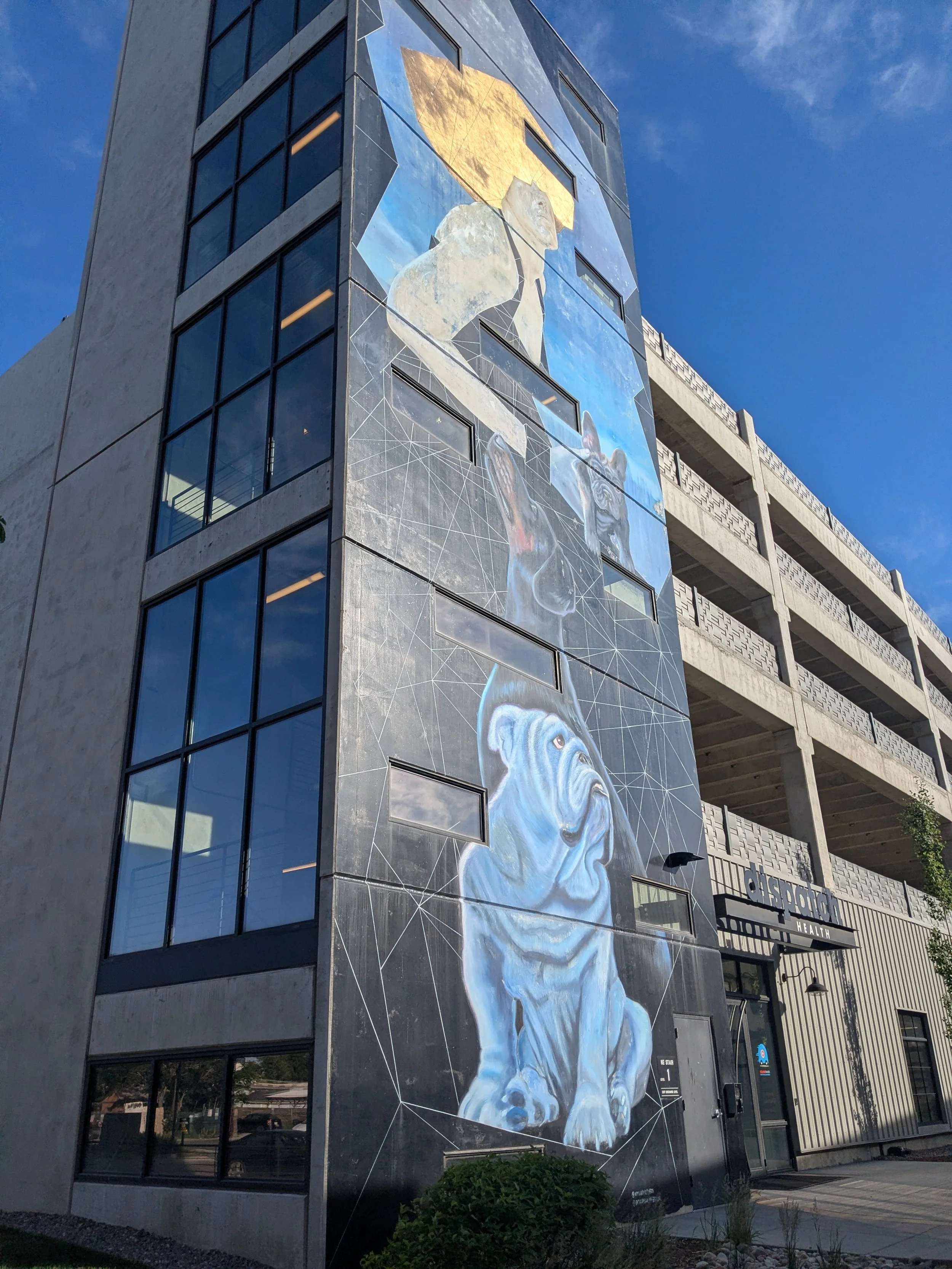
A reminder that art is subjective and there is no accounting for taste, this is on one of many parking garages in the RiNo Arts District.
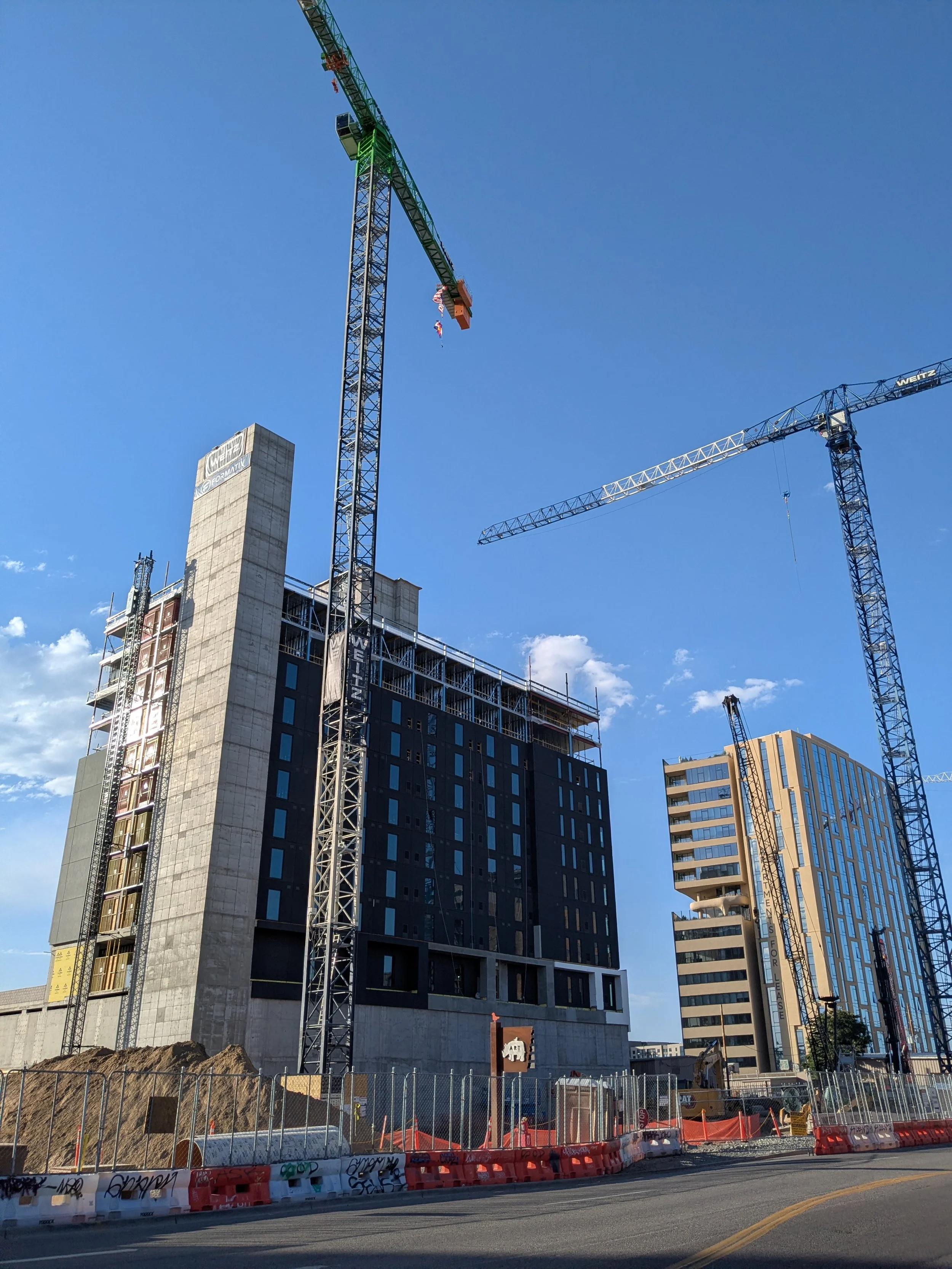
A common scene in Denver's RiNo neighborhood: Construction cranes towering over new apartment buildings
It's the middle of the day, a Sunday, with the pleasant weather that Denver has more often than not. The skies are blue (an increasing rarity, given substantial pollution), the clouds few, and the temperature warm. But best of all right now for me, it's quiet.
There's no wall-rattling bass pounding from DJs at the coffee shop across the street, where management recently saw fit to have an all-day mini music fest promoting Drake's new album (he's still a going concern?) to a dozen or so people. And Sorry Gorgeous, the rooftop bar kitty corner, isn't open yet, so the DJ over yonder isn't flooding the concrete canyon of apartment complexes and towering garage structures with low end, either—though they will again tonight, as they do four nights a week. Oh, joy.
Perhaps hungover from last night's revelries, young men aren't yet racing their souped-up (side note: shouldn’t it be "suped"-up?) sports cars and motorcycles down the too-wide street, a stretch of alley usually ignored by cops, frequented by dog walkers and influencers (and, probably, dog-walking influencers), and riddled with waste.
The neighbors next door aren't slamming the wooden gate that bridges their garage and my temporary home. They aren't blasting a boombox against my bedroom wall like they did a few weekends ago until nearly dawn.
My neighbor in the larger house at the front of this property hasn't been here in a week, so the walls here haven't been rattled by them, either. (The property manager saw fit to give him use of the garage immediately below my living space after having first promised it to me, so note to self: get landlord promises in writing.)
And my dogs can sleep at length, for now, because the fireworks that have been set off almost every night for the past several weeks are on pause, at least until darkness falls.
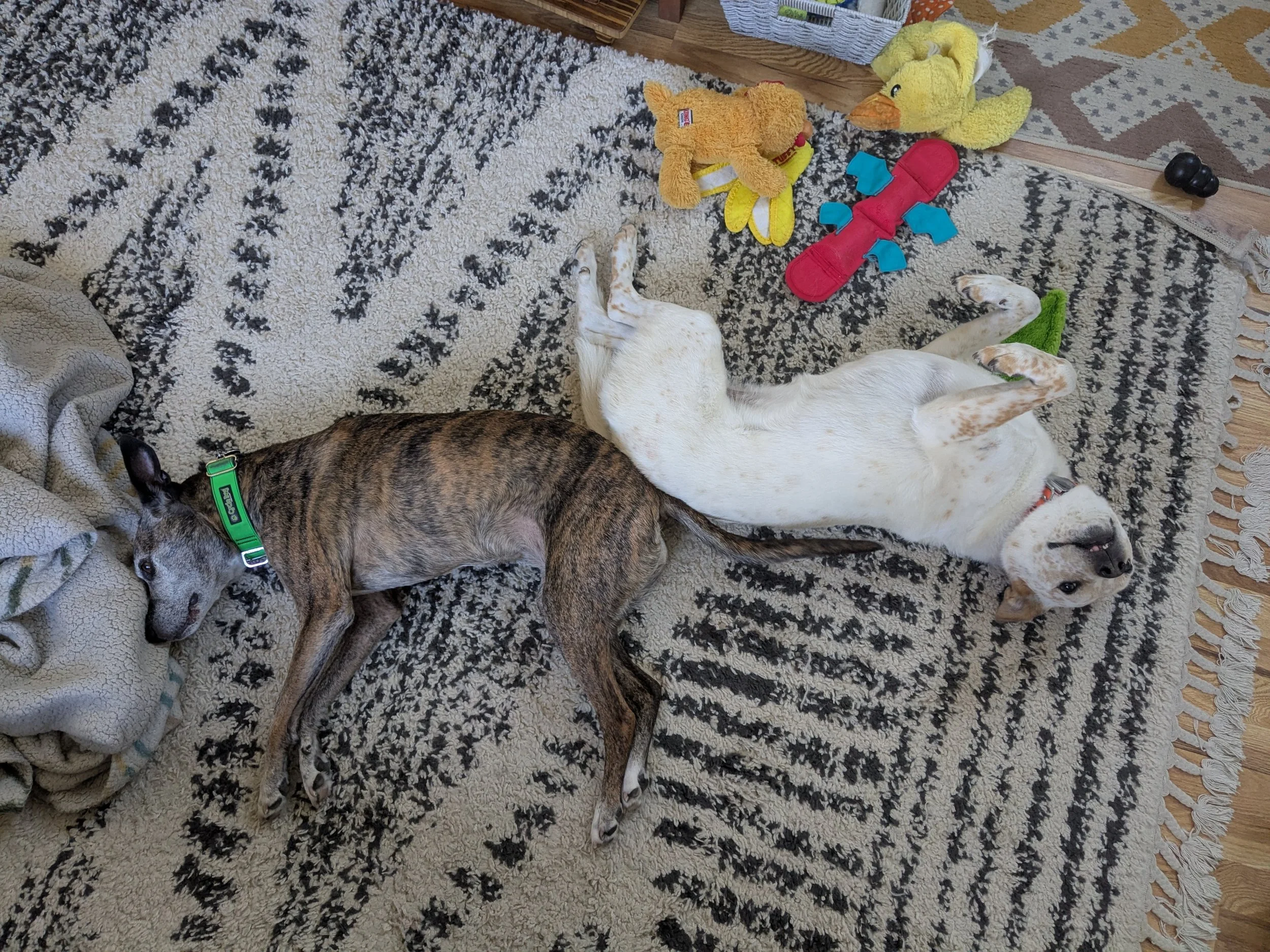
Kaya and Neneh, pre-fireworks
I can concentrate in near silence as I write this. But I know the peace is fleeting. The bass will amp up soon, the doors will slam, the walls will shake once again. (Note: I acknowledge that I live in the “Bass Capital of America” and am not averse to bass-heavy music, having produced it for much of my life.)
I'm privileged: I, unlike many in the neighborhood, have the luxury of being able to move away to a quieter environment soon—one that doesn't flood my brain and body with stress hormones—because I signed this lease, with the house fully furnished, for only 10 weeks. (Thank you, Furnished Finder!)
I also have tools to help me cope: QuietOn (RIP) active noise canceling earbuds, a small but mighty white noise generator, central AC with a powerful and loud fan, and the aforementioned Waking Up meditation app, which I use to help prime my sleep time and forge through what sounds like chaos outside my temporary home’s walls.
But it's not enough. I recently got my first smartwatch, a discontinued Garmin, which has shown me via orange "Stress" bar graphs and Sleep Scores how significantly stressful and impactful the late-night (or early morning, as it were) bursts of bass actually are from the rooftop bar, which increase in volume as closing time nears, inevitably waking me up mid-way through sleep.
I didn’t necessarily take the relative peace and quiet of the previous two neighborhoods I lived in for granted. But the data visualization of being jolted awake and the noise-related stress of this neighborhood has been alarming (so to speak), enough to expedite my move.
It was a difficult choice to put two homes I loved up for sale at the same time. I don't say this from a "woe is me" perspective: I was somehow able to get the places, each at the low end of the price range for the areas, through a fine financial dance which I hoped would allow me to eventually bounce back and forth between the two, having the best of both worlds. But the dance quickly proved impossible to maintain, and a fast growing mountain of debt pushed me to where I am now. Here, tidal waves of sound are giving me similar momentum to move on to the next phase of my domestic life, wherever that is.
I also admit that I might be overly sensitive when it comes to sound. I've been fortunate to have lived in generally quiet places for the majority of my life. But the adverse effects of noise pollution on one's health are real and cannot be denied.
According to Harvard Medicine, "noise pollution not only drives hearing loss, tinnitus, and hypersensitivity to sound, but can cause or exacerbate cardiovascular disease; type 2 diabetes; sleep disturbances; stress; mental health and cognition problems, including memory impairment and attention deficits; childhood learning delays; and low birth weight. Scientists are investigating other possible links, including to dementia."
And with AI data centers popping up seemingly everywhere like something out of a horrific dystopian novel—and municipalities unprepared to deal with the substantial low-end noise they often produce—negative health impacts of living around noise in the modern world are becoming more pronounced.
As part of my mental and emotional health regimen, I’ve been reading Francis Weller’s fantastic book The Wild Edge of Sorrow: Rituals of Renewal and the Sacred Work of Grief. Sitting last Friday afternoon at the beautiful bar of one of my favorite breweries just a 10 minute walk from my place, I was drafting notes for this essay when I took a break to return to the book. The chapter up next, coincidentally (how I love coincidences), was “Silence and Solitude: The House of Our Aloneness”. Of course, with absolutely perfect comic timing, the guy sitting next to me had to start watching videos on his phone with the speaker turned up so anyone within a stone’s throw could hear.
Weller writes in that chapter: “Silence and solitude invite us to pause, to slow down, and to stop. How rare this is in a culture that revels in continuous motion. We live in a highly extroverted culture in which everything is expressed and exposed at all times of day and night. This has led to a coarsening of our language and a dilution in substance. … And yet this pseudo-contact leaves us feeling unseen in the most essential ways.”
Since moving back to the big city, I’ve wondered if part of the reason for so much noise, at least where I live, is American individualism, an "everyone-else-be-damned" mentality, an overt and aggressive focus on oneself. If I want to race my loud vehicle down a street dotted with pedestrians to show off, who's gonna stop me if the cops aren't around? If I want to promote my business by having a no-name DJ in turn promote Drake's latest album in the middle of the day, who's gonna stop me? If I want to watch political videos on speakerphone while having breakfast in my neighborhood diner or sitting in the waiting room at the otherwise quiet doctor’s office, who's gonna stop me?
It's a free country—but apparently "don't tread on me" only applies to those who want to create the noise, not those who want to exist in some semblance of quietness.
"All of humanity's problems stem from man's inability to sit quietly in a room alone."
- Blaise Pascal
“Nobody wants to sit with thoughts. Sitting with thoughts: lame; AI can do that.”
Perhaps simply going about one's business and not making unnecessary noise feels virtually impossible for many of us. After all, how many times did we hear "Sit down and be quiet!" in school, church, or at home? Being quiet can be a punishment, a less severe form of the forced solitude of solitary confinement.
A place can be too quiet. In Leadville, a town of 3,000 people or so, it wasn't often that I heard my neighbors. I rarely saw others when I walked my dogs (which was a blessing, considering they can be reactive around other dogs). But working from home by myself (no offense to my dogs), then going outside on my own and having difficulty making new connections there was not easy and became increasingly dismaying and demotivating. So I chose to move back to the significantly louder Denver.
We humans need a balance: We benefit from solitude and occasional silence, but we also, as social animals, require healthy doses of vital energy shared with our fellow human beings. That balance becomes increasingly difficult to find, though, as Big Tech makes it so easy to be alone, and third places like breweries, libraries, and community centers face their own economic and socio-political difficulties. But we need that balance, we need third spaces, as a strong sense of community (and basic respect of others) becomes increasingly crucial in order to live a happy, healthy life.
I think a large part of our increasingly noisy world comes from people aching to be heard. They make noise precisely because they want attention, and they want attention because they aren't getting it elsewhere in their lives.
It's interesting to see how many people move through the city and their lives with large over-the-ear headphones on: How better to indicate "Don't talk to me!" to others? Yet I can't blame them for likely attempting to fight fire with fire, external noise with their noise-of-preference. I kick myself when I forget my active noise canceling earbuds when I go to a place like that brewery last Friday, and someone else who also doesn’t apparently have earbuds blasts whatever’s on their phone.
Most of this so far has been focused on individuals, but emphasize that the impact of industrialism (and consumerism) is the biggest driver and root source of almost everything loud that I’ve described.
The connected world revolves around the generally noisy automobile and air travel. It was shaped by the military industrial complex. And now it's being increasingly inundated by AI data centers foisted upon neighbors who often cannot afford to move, forcing them to pay the multi-pronged price, which of course is not limited just to noise pollution.
What can we do about noise?
I've chosen to end my multi-year silence on this website by complaining writing about noise. What can we take from this piece?
Know your limits—and respect others’.
Recognize that not everyone has the same threshold for how much noise they can take.
If you work stressful jobs outside your home, in noisy environments, and live in a massive city like Chicago, you might not be bothered by sirens and honking and engines revving at all hours: You're exhausted when you get home, and your home is primarily a place of relative solace for sleep. But if you're like my good friend who lived in an old apartment there for nearly two decades, you might reach a breaking point where the constant cortisol being pumped through your veins thanks to the noise becomes too much. You might just have to move for your sanity, for your health. I know it’s not an easy choice to make, because I’m going through it.
Visualize the impacts of noise.
If you're moving, check out Howloud’s Soundscore map tool, where you can enter an address and see average noise levels from nearby sources before you make the decision to actually move there.
If you have a smartwatch, check your stress levels when noise infiltrates your home. Seeing the dramatic spikes when I’m woken up by the rooftop bar’s DJ most nights of the week was enough to tell me that staying here isn’t sustainable for my well-being.
Slow down and breathe.
Perhaps a silent meditation retreat can help you not only become more comfortable with the concept and practice of being quiet but also give you the ability to take a few breaths, step back and calm down before you become enraged at the nearest noisemaker. (I'm practicing this every. single. day.)
Mark Coleman's silent Nature as Refuge retreat at Rocky Mountain EcoDharma Retreat Center in Colorado is at the top of my bucket list, and if you're just wading into mindfulness, I can't recommend the Waking Up app highly enough (in spite of Sam Harris’s questionable company). Use that link for 30 free days. (And full disclosure: If you end up subscribing, I don’t get a kickback.)
Enjoy reading? Check out Silent Book Club, where you can read a book of your choosing, while choosing your level of interaction with other members.
Go outside and take a walk or bike ride without earbuds in or headphones on, and take in everything—including the noise. You might be surprised by the beauty or things you never noticed before.
And if it’s too quiet?
What if silence and solitude have insidiously morphed into loneliness? I recommend listening to The Reality of Adult Friendship: Here’s Why You’re Lonely & How to Make Real Friends as an Adult, a Mel Robbins podcast episode with great tips on balancing the noise of modern society with the suffering that can come from too much alone time.
Similarly, Cal Newport's book Digital Minimalism has many recommendations on how to survive socially in this brave new world.
See noise.
Noise can be a harmful pollutant. But you can reframe how you "see" noise, like my parents did when I was an adolescent: It's only been fairly recently that they admitted how loud the subwoofer on the floor of my bedroom (immediately above our family living room) truly was—but they were also apparently able to bite their tongues and deal with it, probably in large part because they loved me and knew how much I enjoyed it.
I'm trying to reframe how I see the noise here, taking it as a lesson that I cannot live a healthy life here, that I need to be smarter in my future selection of a home, that no matter how cool a place seems, it might come with some steep costs.
Perhaps I can also reframe the noise here as people generally enjoying themselves. But that possibility won't stop me from moving somewhere with more silence and potential for solitude.
And outlawing gas-powered leaf-blowers if I ever have the chance.